START OF QUIZ
1) What is the highest point in Arizona?
a. Camelback
b. Lukachukai Mountains
c. Humphreys Peak, AZ
d. Sierra Ancha
Answer:
2) What city has the higher density (and is possibly the densest in the world
in terms of people per square kilometer)?
a. Manila, Philippines
b. Bogor, Indonesia
c. New York City
d. Delhi, India
Answer:
3) Which of the following is an example of agglomeration?
a. the location of a tourist facility next to its major market source
b. the location of a tourist facility next to an airport
c. the location of a tourist facility in a rural area
d. the location of a tourist facility in a national park
Answer:
4) A study of the sense of place of residents of a tourist destination would
most likely lie within which geographical research tradition?
a. regional geography
b. spatial studies
c. humanistic geography
d. physical geography
Answer:
5) In the 16th century, the Spanish came over to Inca land and took
over their land. They went to battle, and the Spanish easily won against
the Inca community.
Why were the Spanish known as “accidental conquers”?
a. Due to the geographic location of the Spanish, they had steel, guns and
gunpowder, domesticated animals, and immunity to germs.
b. The Spanish were more powerful because of the food they ate.
c. The Spanish were more experienced fighters and had llamas to help fight
d. Due to the geographic location, the Spanish lived in a small community and
easily practiced battle strategies.
Answer:
6) Which country has the largest population?
a. India
b. China
c. America
d. France
Answer:
7) Time-space convergence refers to
a. the relocation of tourist plant near to transports nodes
b. the way in which the friction of distance in terms of cost and time has generally
decreased over time
c. the way in which the changing structure of transport networks affect the time
taken to travel between two separate points
d. the relocation of tourst plant in urban centres in order to reduce both
distance and time taken to travel to plant
Answer:
8) What is an important reason that skyscrapers were built in American cities?
a. Construction companies liked to build structures that made residents feel as
if they lived in single-family houses.
b. Skyscrapers allowed tenants to create a closer community.
c. Skyscrapers allowed people to use small amounts of land more efficiently.
d. Citizens wanted to be safe from street crime.
Answer:
9) Of the following, which group would most likely be located on sea level land?
a. Hydroelectric plant, national park, reservoir
b. Orchard, coffee plantation, mine
c. Amusement park, ski resort, quarry
d. Railroad, city, airport
Answer:
10) This question refers to the image below.
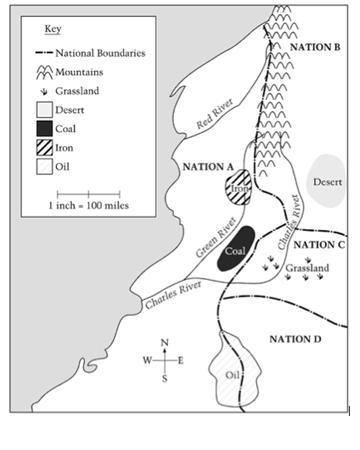
Where would a large city be most likely to develop?
a. In the northeast corner of Nation B
b. Where the Charles River meets the sea
c. The eastern part of Nation D
d. Near the source of the Red River
Answer:
11) In what Canadian city has the CN Tower, North America’s tallest
free-standing structure, located?
a. Montreal
b. Toronto
c. Winnipeg
d. New York City
Answer:
12.) The pattern or process of decreased interaction with distance is
better known as
a. diffusion
b. diachronic analysis
c. distance decay
d. dispersal
Answer:
13) The borders are constantly changing. Established in 2011, what is considered
the youngest country in the world?
a. Eritrea
b. Czech Republic
c. South Sudan
d. Slovakia
Answer:
14) About how many different languages are spoken on this planet?
a. 5,000-7,000
b. more than 10,000
c. 2,000-4,000
d. 1000-1500
Answer:
15) In 1800, fewer than 3 percent of the world's population lived in cities and
towns. As the world entered the new millennium in 2001, what percentage lived
in urban areas?
a. 50 percent
b. 75 percent
c. 25 percent
d. 33 percent
Answer:
16) About how many species of plants are there in the Amazon Rain Forest?
a. 20,000-25,000
b. more than 40,000
c. 15,000
d. more than 80,000
Answer:
17) What city is considered the birthplace of the skyscraper?
a. New York City
b. London
c. Hong Kong
d. Chicago
Answer:
18) Brazil is the leading producer of…
a. Wine
b. Rice
c. Sheep
d. Sugar
Answer:
19) What is the world's oldest capital city, continually occupied for
4,500 years?
a. Beijing, China
b. Baghdad, Iraq
c. Damascus, Syria
d. Cairo, Egypt
Answer:
20) Which is the world’s driest continent?
a. Africa
b. Australia
c. Antarctica
d. North America
Answer:
21) What is the tallest mountain in Antarctica?
a. Kilimanjaro
b. Vinson Massif
c. Elbrus
d. Mount Everest
Answer:
22) What is the longest railroad in the world?
a. Grand Canyon Railway
b. Union Pacific Railroad
c. Trans-Siberian
d. Central Railroad
Answer:
23) Which of the following is the main export of the U.S.?
a. agricultural products (soybeans, fruit, corn)
b. industrial supplies (organic chemicals)
c. capital goods (transistors, aircraft, motor vehicle parts,
computers, telecommunications equipment)
d. consumer goods (automobiles, medicines)
Answer:
24) The West Indies are also known as
a. South Western America
b. The Carribean Islands
c. India
d. Indonesia
Answer:
25) Which country emits the most Green House Gases?
a. America
b. China
c. Canada
d. England
Answer:
26) An atoll is
a. a low coral island consisting of a ring-shaped reef enclosing a lagoon
b. the French word for a nuclear missile testing station
c. a name for island in the South Pacific
d. another name for a barrier reef
Answer:
27) What is the most spoken language in the world?
a. Mandarin Chinese
b. English
c. Arabic
d. Spanish
Answer:
28) Which approach to city development incorporates walkable, transit
orientated, and mixed use communities?
a. City Beautiful
b. Smart Growth
c. Urban Sprawl
d. Urbanism
Answer:
29) What is the leading world economy in terms of GDP?
a. America
b. China
c. India
d. European Union
Answer:
30) Which is the most populated borough in New York?
a. Brooklyn
b. Manhattan
c. Queens
d. The Bronx
Answer:
END OF QUIZ (Note: Only your first quiz submission will be checked.)
|